
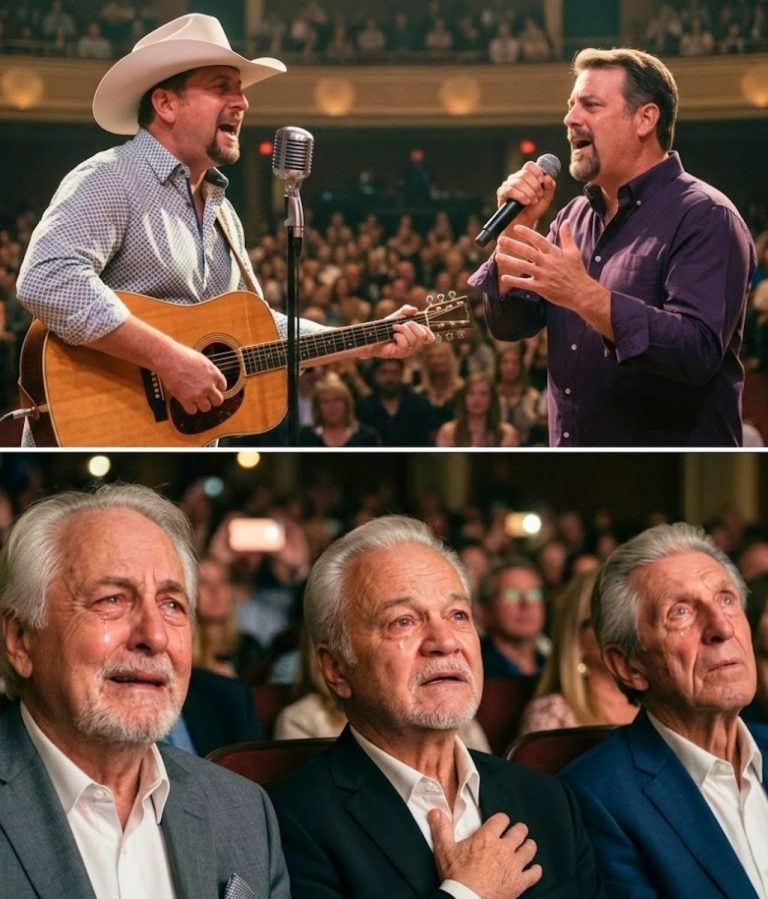
There are moments in music that feel almost beyond explanation—moments when memory and melody meet so powerfully that the line between past and present seems to disappear. One such evening unfolded during a heartfelt performance by Wilson Fairchild, the duo formed by Wil Reid and Langdon Reid. The audience expected warmth, harmony, and perhaps a few stories from the sons of legends. What they did not expect was to hear a voice many believed they would never experience live again.
Standing beneath soft stage lights, Wil Reid paused between songs. The atmosphere shifted subtly—less performance, more reflection. He spoke briefly about legacy, about growing up backstage, about harmonies that shaped not only a career but a family. Then, with quiet reverence, he introduced something deeply personal: a recording of his father's unmistakable bass.
When the first notes emerged from the speakers, the room changed.
It was the rich, grounding tone of Harold Reid—the legendary bass voice that had anchored The Statler Brothers for decades. Deep. Resonant. Immediately recognizable. The sound carried the same authority and warmth that had once filled arenas and church halls across the country.
For a brief, breathtaking instant, it felt as though time had folded in on itself.
Conversations ceased. Faces lifted. Some in the audience closed their eyes, allowing the familiar timbre to wash over them. Others instinctively reached for a hand nearby. The recording had never been publicly heard before, and its unveiling felt less like a novelty and more like a reunion.
Harold Reid's bass had always been more than a musical element. It was the foundation of the Statlers' harmony—steady, faithful, unshakeable. His voice grounded soaring tenors and balanced polished leads. Without it, the architecture of their sound was forever changed. And yet, in that carefully chosen moment, it returned—not as nostalgia alone, but as living presence.
Wil did not attempt to overshadow the recording. He stood quietly, allowing his father's voice to fill the space on its own terms. There was no dramatic lighting cue, no swelling orchestration. Just a pure, unmistakable sound reverberating through the room.
The emotional weight was undeniable.
For longtime fans, the experience stirred decades of memories—vinyl records spinning on turntables, long car rides with familiar harmonies drifting from the radio, concert evenings where applause thundered after a final chord. Hearing Harold's bass again in a live setting felt like revisiting a chapter that had closed too soon.
Yet what made the moment extraordinary was not simply the recording itself. It was the intention behind it.
This was a son honoring his father—not through grand gestures, but through the gift of sound. Through a voice preserved with care and shared with gratitude. It was a reminder that while a life may conclude, its resonance continues.
When the recording faded, the silence that followed was profound. Not empty, but reverent. Then applause rose—steady and heartfelt. Not merely for a performance, but for a legacy remembered with tenderness.
Music has a remarkable way of defying finality. It lingers in archives, in memories, in the hearts of those who once sang along. On that unforgettable night, Harold Reid's bass did not simply echo from speakers. It returned as a bridge between generations—a reminder that harmony, once formed in love and faith, is never truly lost.
For those present, it felt nothing short of miraculous. And as the evening moved forward, one truth remained clear: some voices, no matter how much time passes, still find their way back to the stage.