
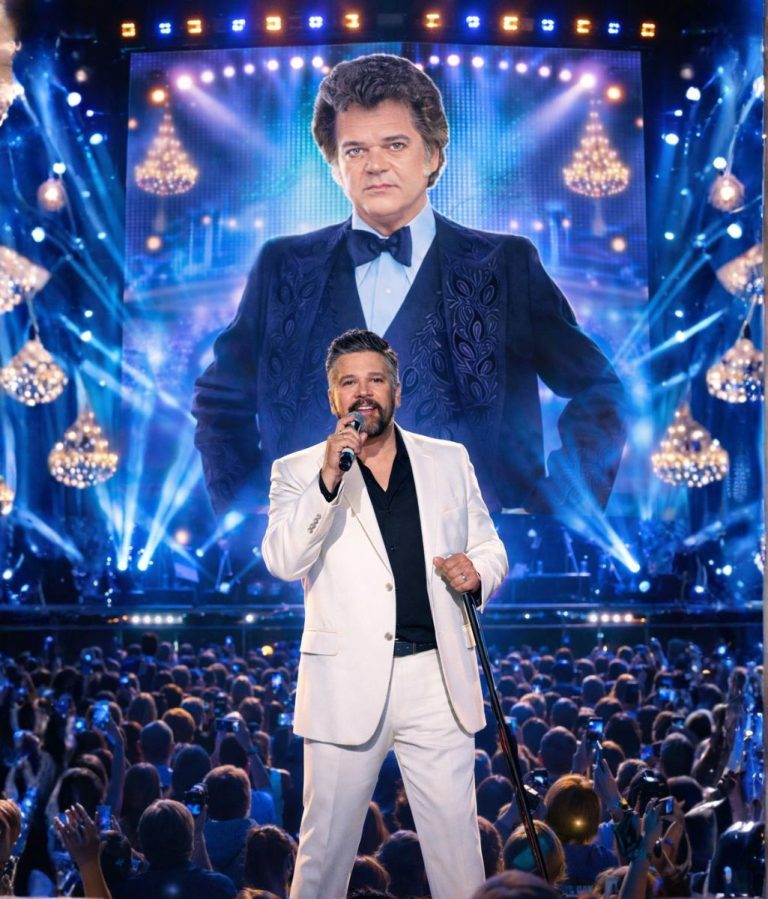
 There are moments on stage when the air itself seems to pause.
Not because of spectacle.
Not because of noise.
But because something deeply personal is about to unfold.
When Tre Twitty stepped beneath the lights, the crowd sensed it immediately. This was not just another performance. It was lineage. It was memory standing upright in the present.
He wrapped both hands around the microphone, steadying himself. The tremor in his fingers was subtle, but visible. The kind that comes not from fear, but from emotion rising too quickly to contain.
Behind him, the band waited quietly.
Somewhere in the audience, older fans leaned forward. They knew the name. They knew the history. They had grown up listening to Conway Twitty sing of longing, devotion, and the fragile beauty of love.
And now, a grandson stood ready to sing it back.
The first note left Tre's lips gently — not imitating, not competing, but honoring. His voice carried its own texture, shaped by a different generation, yet unmistakably tethered to the past. It was not about perfection. It was about reverence.
The dedication was unspoken but understood.
Every lyric felt like a bridge.
Between decades.
Between stages.
Between a young man and the grandfather whose songs still lingered in living rooms and late-night radio.
As he moved into the chorus, his voice strengthened — not louder, but surer. The crowd remained still, almost protective of the moment. There was no shouting, no restless movement. Just listening.
Tre did not attempt to replicate the velvet baritone that once filled arenas. He sang with his own breath, his own phrasing, his own heartbeat. And yet, within the melody, echoes of Conway's spirit could be felt — not as shadow, but as foundation.
Halfway through the song, emotion caught him briefly. His eyes lowered. A breath held a fraction longer than planned. For a second, it seemed he might step back.
But he didn't.
He leaned into it.
That vulnerability transformed the performance from tribute to testimony. It was no longer about legacy alone. It was about gratitude.
Silent tears glistened under the stage lights — not dramatic, not staged. Just real. Real love for a man whose voice shaped country music history. Real respect for the weight of carrying that name.
In the final verse, the audience began to hum along softly. Not overpowering him. Supporting him. As if to say: We remember too.
When the last note faded, Tre did not raise his arms triumphantly. He bowed his head for a moment. A quiet acknowledgment. A private thank you carried in public view.
The applause that followed was warm, sustained, and deeply felt.
Because what the audience had witnessed was not nostalgia.
It was continuity.
When a grandchild's voice rises under the stage lights, the entire space does hold its breath. Not out of doubt — but out of hope. Hope that the music will endure. Hope that love can travel through bloodlines. Hope that the past can be honored without being trapped there.
That night, Tre Twitty did more than sing a dedication.
He proved that legacy is not about standing in someone else's shadow.
It is about stepping into the light — carrying love, respect, and memory — and letting the song live again.